The German electricity market design is based on the assumption that electricity can flow from the generation plant to the consumer regardless of geographical location. Physical restrictions due to the transport and distribution capacities of the power grids are not taken into account in energy trading (in futures, day-ahead, and intraday trading). Limiting trade volumes are only specified in cross-border trading. It is the responsibility of grid operators to ensure within their respective grid areas that the feed-in and withdrawal volumes resulting from trading do not exceed the applicable physical grid restrictions, thereby preventing grid bottlenecks. A key instrument for grid operators to achieve this is redispatch: grid operators specifically adjust the planned active power feed-in or electricity consumption of individual plants to counteract a grid bottleneck. While there is a priority for renewable energy feed-in, the goal is simultaneously to operate the grid within permissible operating limits through the most cost-efficient interventions possible.
Previously, the dimensioning of the power grid was primarily determined by connected consumer loads and central generators at higher voltage levels. Today and in the future, grid expansion in some grid areas will be designed based on the profiles of decentralized renewable energy sources. In these regions, where grid expansion is necessary or not the most cost-efficient solution, (partly structural) bottlenecks occur, which can lead to large volumes of redispatch measures with corresponding costs. In the 2nd quarter of 2026, the redispatch volume in Germany was 5,263 GWh and the associated costs amounted to 673 million euros. The costs of redispatch measures are incorporated into grid fees. A cost-efficient design of bottleneck management is therefore also relevant from a macroeconomic perspective.
Therefore, it is particularly important that battery storage systems are efficiently and fully integrated into existing redispatch processes in accordance with Redispatch 2.0. To date, grid planning has focused primarily on plan-value-based procedures. In addition, curative redispatch could prospectively offer an extra opportunity to better utilize existing grid capacities. From Kyon Energy's perspective, it is crucial that the procurement of the necessary measures is cost-neutral for the storage operator or, if possible, even market-based. Curative redispatch should not be viewed in isolation: consistent integration into preventive redispatch processes and grid expansion remain necessary. Flexibilities such as large-scale battery storage should not be an exception to the mechanisms already legally provided for under Section 13a of the German Energy Industry Act (EnWG).
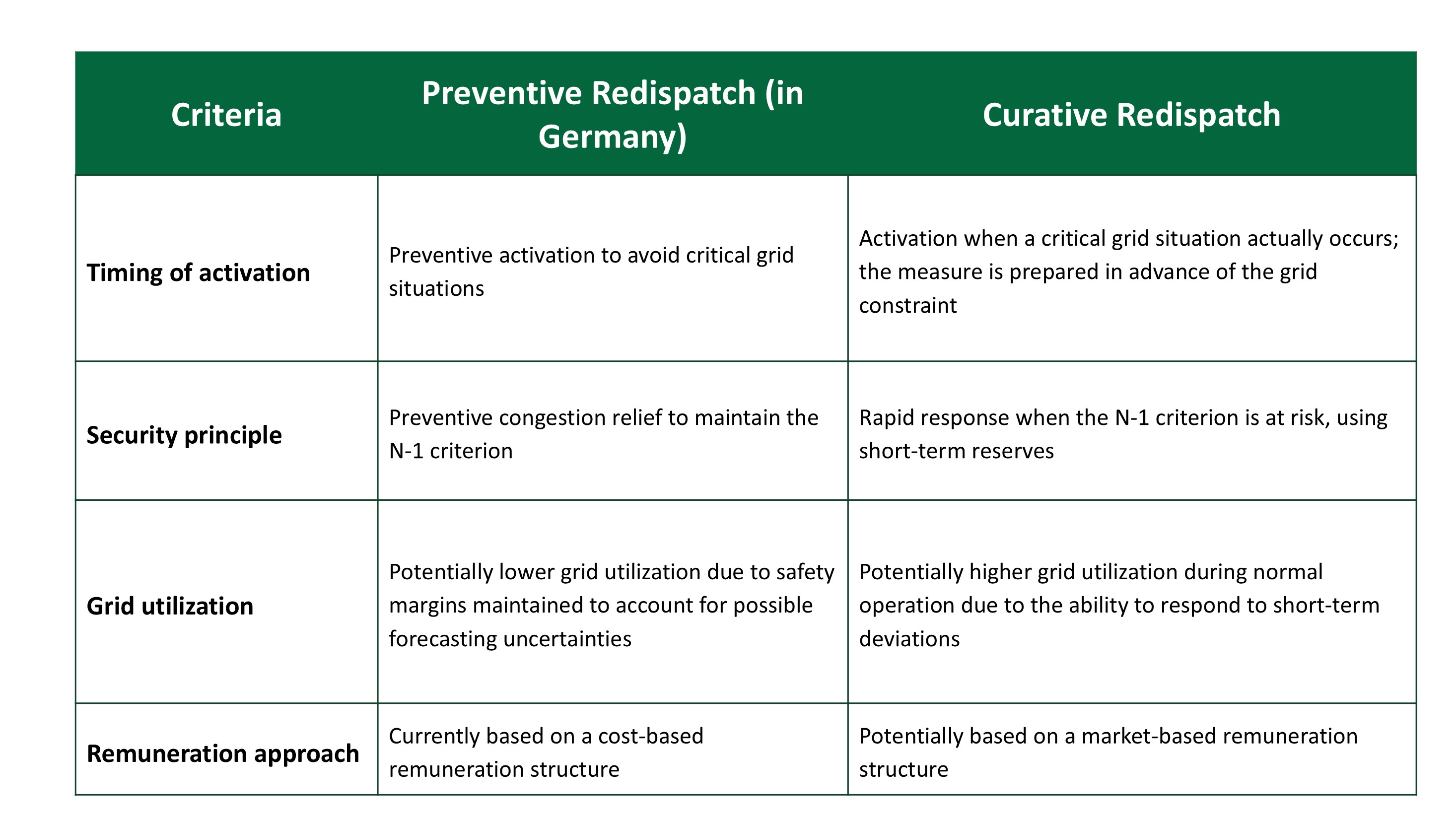
When people generally talk about redispatch, they are usually referring to preventive redispatch. In this process, grid operators continuously forecast potential grid bottlenecks in advance, up to a cut-off point before the planned delivery. Depending on how the grid operator structures this process, this data is determined by the responsible grid customers via queries of plan values or self-generated forecast data. Based on this information, they identify potential bottlenecks and react preventively by requesting individual market participants to carry out a redispatch measure. This redispatch procedure is intended to determine ex-ante whether critical bottlenecks will occur and to prevent them by specifying or limiting the active power feed-in and consumption of individual connection users.
The described preventive redispatch mechanism is intended to ensure the security of grid operation through e.g., n-1-secure utilization of all relevant assets through proactive active power adjustments. So-called n-1 security guarantees that even in the event of a failure of a critical asset, no further failures or overloads will occur. Through this procedure, the existing grid infrastructure is deliberately not fully utilized during normal operation, as the power grid must remain stable even if an asset fails. However, these mechanisms, which are based on forecasts and plan values, are made more difficult by additional connection users and increasing forecast uncertainties. To compensate for this, higher safety margins could be introduced, which could entail higher redispatch volumes and costs. An alternative could be achieved by establishing a curative redispatch approach.
In Germany, curative redispatch currently exists only as a concept and within the framework of the KuPilot research project. From Kyon Energy's perspective, the goal would be to build on this to structure a new system service. By bindingly agreeing in advance to provide quickly available, controllable capacities, this ensures that if the n-1 criterion is not met in the power grid, critical assets can be relieved through the targeted control of the contracted power. This mechanism allows for higher utilization of the power grid by reducing the safety margins that may be required in purely preventive redispatch processes. Through the combination of preventive and curative redispatch, grid bottlenecks are first forecast ex-ante and resolved within the framework of preventive redispatch. Should bottlenecks still occur due to deviations, the contracted capacity remains available to restore the n-1 criterion via curative redispatch. The capacity is therefore only held in reserve and only activated when needed, rather than before a grid bottleneck has occurred, as is the case with preventive redispatch. Thus, curative redispatch is not an alternative to preventive redispatch, but an additional instrument that could enable more efficient use of existing grid infrastructure.
The curative approach opens up the possibility of efficiently utilizing critical grid assets despite increasing uncertainties, and can thus help to reduce or postpone the need for additional grid expansion.
Today, however, implementation would not be possible without regulatory adjustments. The instrument would need to be further defined and tendered similarly to existing system service markets. A concrete implementation strategy was developed, for example, in the context of a study by Consentec commissioned by Amprion. In this model, the grid operator communicates its binding requirement for capacity to be held in reserve with sufficient lead time (d-2). This capacity is then awarded locally through a market-based procurement process. Grid users who can provide this capacity within a specified time (5 minutes is proposed) are eligible to offer it. During the reservation period, no further market participation is possible for the grid user with the capacity being held. The local tendering of such a product could be challenging. The repercussions on price formation in this regard need to be investigated further.
Regardless of the introduction of curative redispatch, it is necessary to integrate large-scale battery storage systems into the current redispatch framework within the existing legal parameters. Kyon Energy welcomes the consultation on the further development of Redispatch 2.0. Given the increasing utilization of existing grid infrastructure and the loss of so-called positive redispatch potential from thermal power plants, storage systems can play a valuable role if they are consistently incorporated into the cost-compensated measures of preventive redispatch. At the same time, we see that the introduction of curative redispatch as an additional instrument could solve another problem: the tension between increased forecast uncertainties and the goal of maximizing grid infrastructure utilization.
In Kyon Energy's assessment, additional curative redispatch is well-suited to better utilize existing grid infrastructure. Here, too, large-scale battery storage can make a valuable contribution by providing the resources necessary for curative redispatch. They are quickly activatable, precisely controllable, and offer both charging and discharging capabilities, making them a versatile tool for market-organized congestion management.
With the ongoing expansion of storage projects, significant capacities could be available for integration into preventive and curative congestion management in the short term. To maintain the bankability of these storage facilities, it is essential that their integration is transparent and appropriately compensated. This applies regardless of whether procurement processes are cost-based or market-based.


