Large-scale battery storage systems are no longer an issue for the future. In 2026, more and more plants will be put into operation in Germany. By operating based on market prices, you are already making a contribution to a resilient and sustainable electricity system: You lower the costs of electricity generation, reduce CO₂ emissions, stabilize prices and enable better integration of renewable energies.
At the same time, the new Short study on the system usability of large batteries of Neon New Energy Economicsthat a significant part of their potential, in particular for reducing network and redispatch costs, remains unused so far. The reason is not the technology — but the lack of regulatory incentives. A balanced set of rules that penalizes harmful behavior and at the same time creates positive incentives to make storage systems operational for all actors would be crucial to promote network and system serviceability of storage systems.
As a result of trade transactions on power exchanges, large batteries are already doing exactly what an increasingly renewable energy system needs: They move electricity from times of abundance to times of scarcity. When batteries charge at low prices and discharge them at high prices, the price level falls for all consumer groups: cheap, often renewable, generation is increasingly used, flexibilities replace expensive, mostly fossil, peak load power plants.
A separate study impressively quantifies this effect: In 2024, a single battery with 100 MW output generated economic added value of over 9 million euros on the day-ahead market alone. There are also positive effects in intraday trading and in the control energy system, where batteries are particularly efficient thanks to their rapid responsiveness and without minimum generation. Overall, they lead to lower price volatility, less regulation of renewable energies and falling CO₂ emissions.
While the effects of large batteries on electricity markets and markets for system services have been completely internalized through prices, this has not yet been the case for the effects of their schedules on the power grid. In the uniform German electricity price zone, batteries — like all market participants — are blind to the grid. Operators do not receive any dynamic signals from network operators as to whether their schedule has a positive or negative impact on network costs. The network economy analysis is carried out downstream as part of redispatch, which can mean a cost-neutral timetable adjustment at the request of the network operator in the event of bottlenecks.
The study shows: In the current system, large batteries are already relieving the grid on average and reducing redispatch costs per installed kilowatt by several euros per year. However, this effect is not systematically guaranteed. In individual situations, batteries can also increase grid bottlenecks — not due to misconduct, but due to a lack of incentives. As a result, a significant part of their reduction potential for network expansion and redispatch remains unmatched.
Against this background, the political debate about the “network-service” of storage systems has recently gained considerable momentum. Among other things, differentiated network charges, flexible grid connection contracts, restrictions on short-term marketing and new technical requirements such as performance gradients will be discussed.
However, the study expressly warns against an uncoordinated variety of such individual instruments and against competing approaches from different network operators. Such regulatory disharmony entails the risk that the necessary ramp-up of large battery storage systems will come to a standstill and that insufficient storage can be integrated into the power system. A demand for network-friendly behavior is therefore understandable, but must not jeopardize the economic efficiency of storage systems through targeted measures.
This would be particularly problematic because large batteries are the only relevant asset class today that is completely free of subsidies. A worsening of the framework conditions would not only slow down the energy revolution, but would also send the wrong signals in industrial policy.
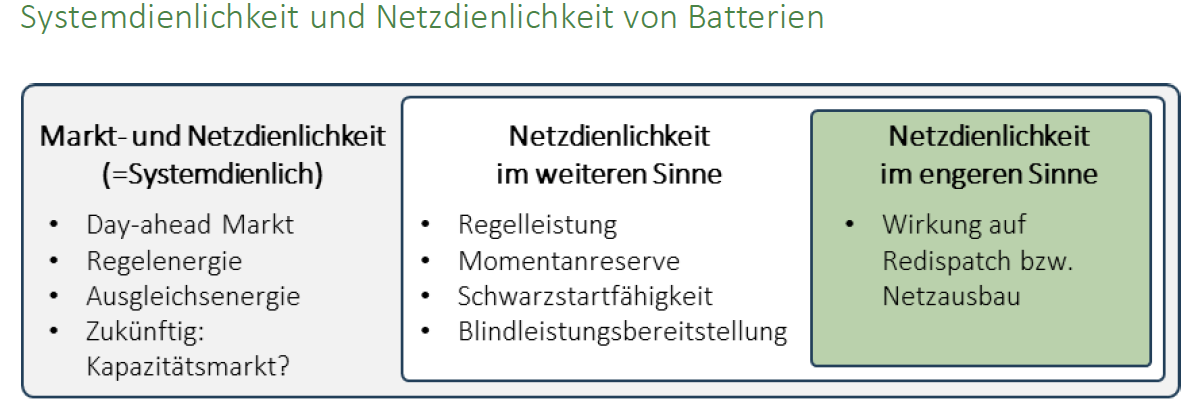
Instead of often far-reaching interventions, what is needed is a consistent set of instruments that target where network or system costs arise. A key finding: The location of a battery ('North or South') is less important than its mode of operation. Incentives such as construction subsidies, which alone influence the choice of location, fall short. Effective network relief only occurs when the level of network load is included in the preparation of timetables. With the help of, for example, dynamically symmetrical network charges, local network bottlenecks could be reflected and thus positive incentives could be created for storage operators to actively contribute to grid stability.
This requires:
Network service is not an end in itself. A storage system that has a load on the grid in certain situations can also make economic sense if its market or system benefits exceed the additional network costs. This would be the case, for example, if a storage system provides control power. The yardstick of regulatory action must therefore always be the minimization of the overall costs of the energy system — not the isolated optimization of individual sub-areas.
The study confirms what has long been shown in practice: Large-scale battery storage systems are already one of the most important components of the energy revolution. Their contribution to security of supply, cost efficiency and climate protection is significant. With cleverly designed, economically consistent framework conditions, this contribution can continue to grow significantly.
Kyon Energy is committed to ensuring that battery storage systems are not only integrated quickly but also intelligently into the energy system. It is now crucial to set the right course so that storage systems can develop their flexibility where they create the greatest benefit for the market, network and society.


.avif)