The ongoing expansion of renewable generation capacity is leading to a significant shift in electricity supply requirements in Germany. In 2025 alone, the installed capacity of photovoltaic and wind power plants increased by nearly 21 GW to a total of around 210 GW. At the same time, the installed capacity of dispatchable power plants, such as coal-fired stations, is decreasing. These developments are altering the temporal and regional patterns of electricity feed-in, leading to more frequent situations where electricity generation and consumption are not aligned. The need for flexibility in the energy system is rising, particularly during periods of very high or very low renewable energy generation.
A visible sign of the growing need for flexibility in the power system is the increased number of hours with negative electricity prices on the day-ahead market. In 2025, a total of 573 hours with prices below zero euros per megawatt-hour were recorded, compared to 457 hours in 2024. Such price phases occur primarily when wind and solar energy generate high feed-in volumes simultaneously and electricity supply exceeds demand across the entire price zone. Negative electricity prices are not necessarily a problem; fundamentally, they are an important market signal. They create incentives to activate flexible consumers, storage systems, or controllable loads during times of high renewable generation. However, sharp price spikes—both upward and downward—and their increasing frequency are becoming critical. At the same time, these negative price phases show that there is currently a lack of sufficient regional flexibility incentives to better manage local supply surpluses.
Against this backdrop, battery storage systems are gaining importance. They can shift energy over time, absorbing or providing it at short notice, thereby meeting both market and system requirements. Due to their technological characteristics, they are particularly well-suited for services that require high response speeds and precise power control.
In principle, large-scale battery storage systems are technically capable of trading a variety of products on electricity exchanges and providing system services. This includes, for example, the provision of control reserve and, in the future, synthetic inertia to support grid frequency. Large-scale battery storage can react to fluctuations in grid frequency within a very short time and compensate for them by feeding in stored energy during a frequency drop or absorbing excess energy during a frequency rise. This rapid response capability makes them an ideal tool for frequency maintenance.
Furthermore, they support the integration of renewable energies by storing their volatile power output and making it available to energy markets at a later time. This enables the continued economic expansion of renewable energy plants.
Flexibility on both the load and generation sides is more necessary than ever today because the energy system is undergoing a fundamental change. While in the past, non-controllable consumption was balanced against controllable generation, today both consumption and generation are at least partially volatile and only limitedly controllable. Therefore, flexible elements like large-scale battery storage are becoming indispensable for a stable energy system, ensuring that the amount of electrical energy fed into the grid always matches the amount being drawn.
Today, large-scale battery storage systems are marketed through a combination of several markets. On the day-ahead market, the operating strategy for the following day is traded based on forecasted price trends, while intraday trading on spot markets handles very short-term power requests. In addition, storage systems provide control reserve: FCR (Frequency Containment Reserve) reacts to frequency deviations in the range of seconds, while aFRR (automatic Frequency Restoration Reserve) and mFRR (manual Frequency Restoration Reserve) operate in the minute range. Battery storage excels here due to its technical precision, as it can deliver requested power almost instantaneously. With the increasing installed capacity of renewable generation, it is expected that other flexibility products will gain importance in the future. These include, for example, redispatch applications, provided the regulatory framework allows for it, as well as the provision of synthetic inertia.
This makes their marketing logic fundamentally different from classic dispatchable plants like gas-fired power stations, which are limited in their flexibility by start-up times and minimum run times. A battery storage system, by contrast, can switch between charging, discharging, and standby within a very short time.
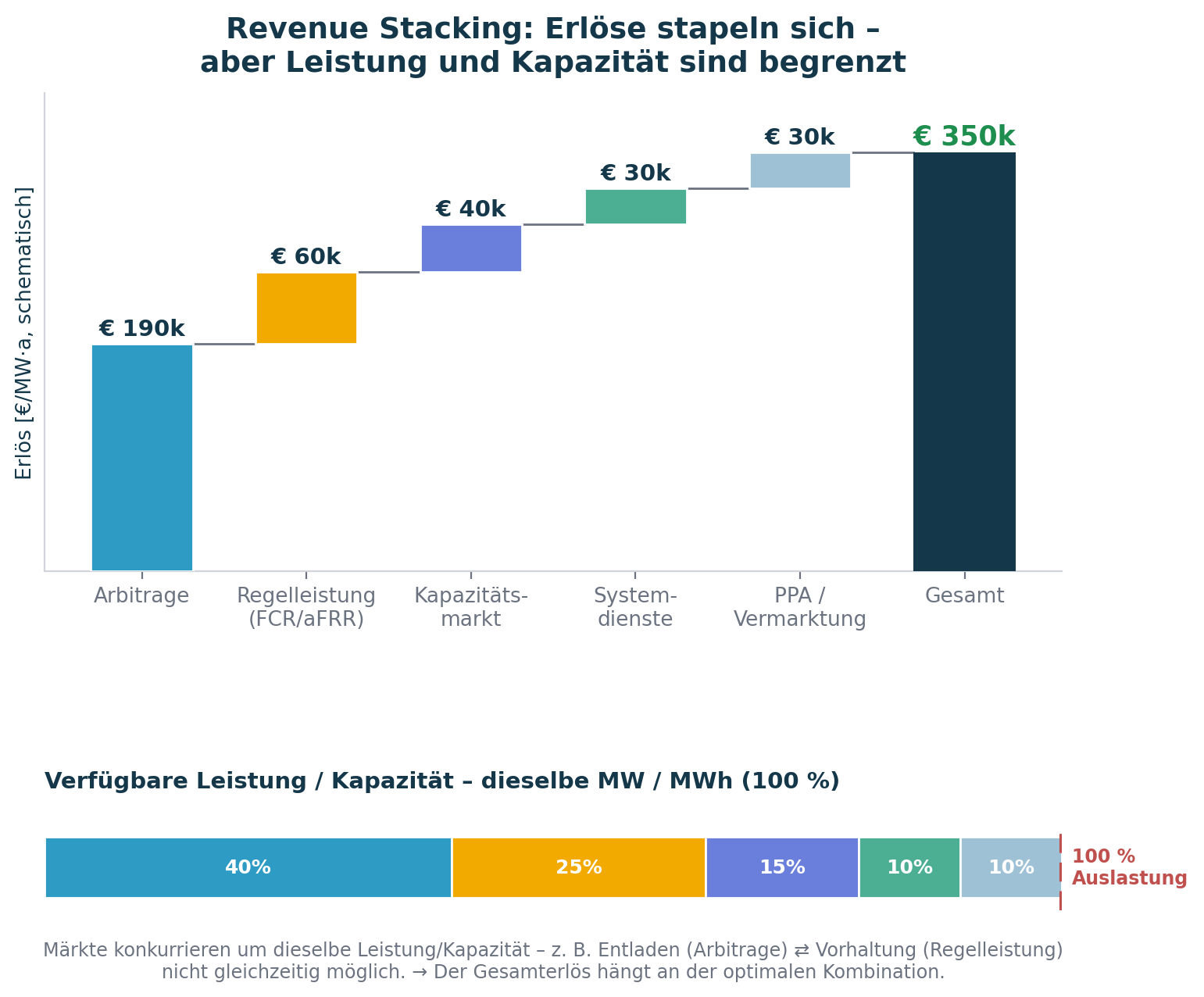
Since no single market offers consistently attractive returns on its own, multi-market or cross-market optimization has become established: the dynamic shifting of available capacity between control reserve and spot market products, depending on where the higher revenue can be achieved.
Another approach is co-location with solar or wind farms. The advantage here is that the battery can absorb excess generation that would otherwise have to be curtailed, and grid connection capacities can be shared. At the same time, this joint operation increases the capture rate of the generation plant and the revenue potential of the energy produced. For co-location projects, the operating range of the battery is sometimes tied to the generation characteristics of the plant. As a result, it can be less freely aligned with the market. A stand-alone storage system is more independent in its marketing but bears the costs and risks of its own grid connection alone.
Today, the revenue of a large-scale battery storage system is essentially derived from control reserve and arbitrage trading. Control reserve revenue results from holding capacity available, regardless of actual activation. Arbitrage revenue is generated by shifting energy over time between periods of low and high prices.
The level of revenue depends on several factors: the location, which determines grid connection costs and market access; the storage capacity and the power-to-capacity ratio; the number of cycles, which balances revenue against battery degradation; and market volatility, which determines the revenue potential from time-shifting.
The stand-alone battery storage system in Arnsberg, North Rhine-Westphalia, demonstrates how this marketing logic can be applied in practice. The facility is not operated in conjunction with a solar or wind farm but is marketed independently, with its operation dictated exclusively by market signals.
QUADRA energy deploys the storage system across relevant markets—from frequency containment reserves to wholesale markets—via its proprietary Q.nect platform. The platform continuously re-evaluates which market promises the highest revenue at any given time, optimizing the operating schedule and trading transactions in real time. The site also illustrates how grid connection capacity, storage capacity, and regional market conditions collectively determine the most economically viable marketing strategy. Currently, the aFRR market is providing a high, stable value contribution, complemented by the sometimes extreme spreads in the intraday market, which arise from the enormous volatility in electricity markets and can be specifically leveraged to optimize flexible assets. In May and June 2026, the high volatility in the electricity market created an exceptional environment for this, driven by high solar feed-in, a lack of system flexibility, increased electricity consumption partly due to heat, and low wind generation during evening hours.

Looking at the regulatory framework, it is clear that large-scale battery storage systems have so far been operating in a market environment that only partially reflects their actual contribution to the system. While large-scale battery storage systems already provide valuable services for system stability and security of supply today, they—like any asset operated on a market basis—respond to electricity market price signals, which are currently largely uniform and mostly system-blind. Battery storage systems therefore only "see" those effects that are fully captured in the market price: short-term price fluctuations, arbitrage opportunities, or revenue from balancing services.
The central regulatory task is therefore to design price-based incentives in such a way that large-scale battery storage systems can provide both market-based and grid-serving system contributions. The better external effects are internalized, the more battery storage systems can unlock their full potential and contribute to a cost-efficient, flexible energy system.
Transparency note: This article was produced in collaboration with QUADRA energy.


.avif)