What is the maturity-based allocation process? This process is used to allocate grid connection capacities within the transmission grid. Its goal is to prioritize the allocation of available capacity to projects that are already at an advanced stage of development and have a high probability of being realized. Unlike the previous first-come, first-served approach, the timing of the application is no longer the sole factor in determining a project's priority. Instead, evidence and project progress are taken into account to assess the feasibility of a project. Relevant criteria include, for example:
A maturity level is determined based on these criteria. Projects with a higher maturity level are given priority when allocating grid connection capacities. At the same time, minimum requirements must be met to participate in the process. A key feature of the maturity-based process is the regular reassessment of projects, which allows progress made to be taken into account in subsequent evaluation rounds.
The maturity-based process is carried out in regular cycles and is divided into three consecutive phases, followed by a pre-project phase. The process outline illustrates the basic flow of the procedure:
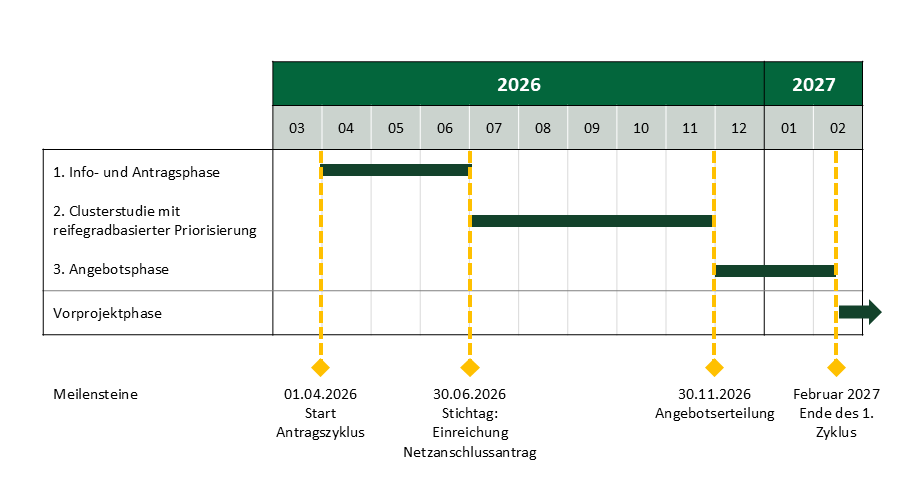
At the beginning of a process cycle, transmission system operators provide information on available grid connection capacities and the requirements for submitting an application. Project developers can then submit their applications and provide the necessary documentation.
Once applications have been received, the projects are reviewed and evaluated. Projects are assessed and prioritized based on the defined maturity criteria. Subsequently, the transmission system operators check, in accordance with the determined order, how available grid connection capacities can be allocated and whether the projects are technically feasible within the grid.
Applicants will receive feedback on the evaluation results. Grid connection capacities can be reserved for prioritized projects.
Once a grid connection offer has been accepted, the next steps involve finalizing the grid connection details and drafting the contracts.
Allocation procedures and maturity-based assessment methods pursue the same goal in both transmission and distribution grids: the transparent and non-discriminatory allocation of scarce grid connection capacities based on predefined criteria. All requests are submitted by a cut-off date and then evaluated in order of merit according to these predefined criteria. Projects with higher scores are given priority in the event of capacity bottlenecks.
The current approaches taken by distribution system operators (DSOs) share some fundamental similarities with the maturity-based assessment methods used by transmission system operators. Here, too, requests from storage facilities and grid users are collected and evaluated in defined cycles rather than being processed solely on a first-come, first-served basis. The evaluation partially incorporates grid-related aspects such as the efficiency of grid connection usage, flexibility features, or regional grid requirements. At the same time, a distinction is made between the different asset classes themselves, for example, by cross-referencing them with the currently applicable regional scenario.
This reflects a general trend moving away from the traditional first-come, first-served principle toward structured, criteria-based allocation procedures. Both at the transmission and distribution grid levels, this is intended to ensure that scarce grid connection capacities are only awarded to projects that have already invested significant resources into their development.


.avif)

